


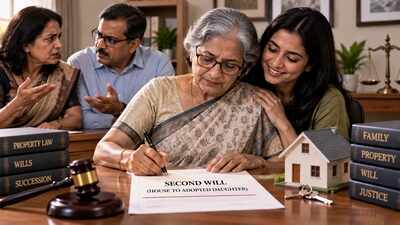
A property dispute between two sisters over a six-room house in Ludhiana has reached the Supreme Court after the Punjab and Haryana High Court ruled in favour of the elder sister’s adopted daughter. The dispute concerns a house built on 79 square yards of land and owned by a childless widow.The woman had a younger sister and a brother, who lived nearby. The brother used to visit and care for his sister as she grew older. On February 15, 2008, the woman Kaur revoked her first Will, which had originally intended to leave the property to the younger sister after her death.The brother died in the last week of December 2009, leaving the woman alone at the house. She subsequently adopted her younger sister’s daughter as her own.In January 2010, the woman travelled to Mayya Da Dera in Phillaur to attend a function and locked her house before leaving. According to her case, her younger sister and her brother-in-law used the opportunity to enter the property and take possession of it. They allegedly continued living there, while the woman was denied access to her own house.About five months later, she approached the court. During the litigation, she executed another Will on March 15, 2013, leaving the Ludhiana property to her adopted daughter after her death.The woman died before the High Court delivered its final judgment. On July 15, 2026, the Punjab and Haryana High Court ruled in her favour. The dispute has not ended, however, as the younger sister has challenged the judgment before the Supreme Court through a special leave petition (SLP). The Supreme Court’s decision is pending.
Why Punjab and Haryana High Court upheld the second will
Jyoti Sinha, Partner at Khaitan & Co told ET that the woman succeeded because the High Court treated the matter as one involving testamentary succession under a Will rather than intestate succession.According to Sinha, the court found that the woman’s ownership of the property was supported by the records, while the younger sister’s competing claim was based on an alleged agreement to sell had not been established.The High Court also accepted the validity of the woman’s later registered Will after it was proved through an attesting witness. In reaching its conclusion, the court relied on the Supreme Court’s judgment in Mathew Oommen vs. Suseela Mathew, which held that a person can act as both the scribe and an attesting witness to a Will.Sinha said: “As a result of the high court judgement, the property passed to the adopted daughter under the Will, rather than under the succession rules applicable to a female Hindu dying intestate. However, the younger sister has since challenged the Punjab and Haryana High Court’s decision by filing a special leave petition before the Supreme Court and it remains to be seen if the Supreme Court agrees with this position.“Justice Vikas Suri heard the case in the Punjab and Haryana High Court. The court distinguished between a “mere scribe” and someone who is both the scribe and an attesting witness. A scribe is the person who drafts or writes a Will.Merely preparing a Will and signing it does not automatically make the person an attesting witness. What matters is whether the person signed with the intention of attesting the document.Sinha said: “However, relying on the Supreme Court judgment in Mathew Oommen Vs Suseela Mathew, the court held that there is no legal bar on the same person acting as both scribe and attesting witness if the evidence shows that he signed with the intention to attest.”In this case, an advocate who drafted the Will had also signed it as an attesting witness. The High Court therefore found that he was not being treated as an attesting witness simply because he had prepared the document. Instead, the evidence showed that he had signed in the capacity of an attesting witness while also serving as its scribe.The High Court referred to the Supreme Court’s January 3, 2006 judgment in Civil Appeal No. 2034 of 2003, Mathew Oommen vs. Suseela Mathew, reported in (2006) 1 SCC 519. The judgment established that there is no legal requirement preventing a scribe from also being an attesting witness to a Will.The High Court said: “However, it is trite law that a scribe cannot be “treated” as an attesting witness to a Will. In the case at hand, the factual matrix is not that a scribe has been treated as an attesting witness. Rather, one of the attesting witnesses has also signed as a scribe.”Sinha added: “This legal position is expected to be examined by the Supreme Court in a pending special leave petition.”