


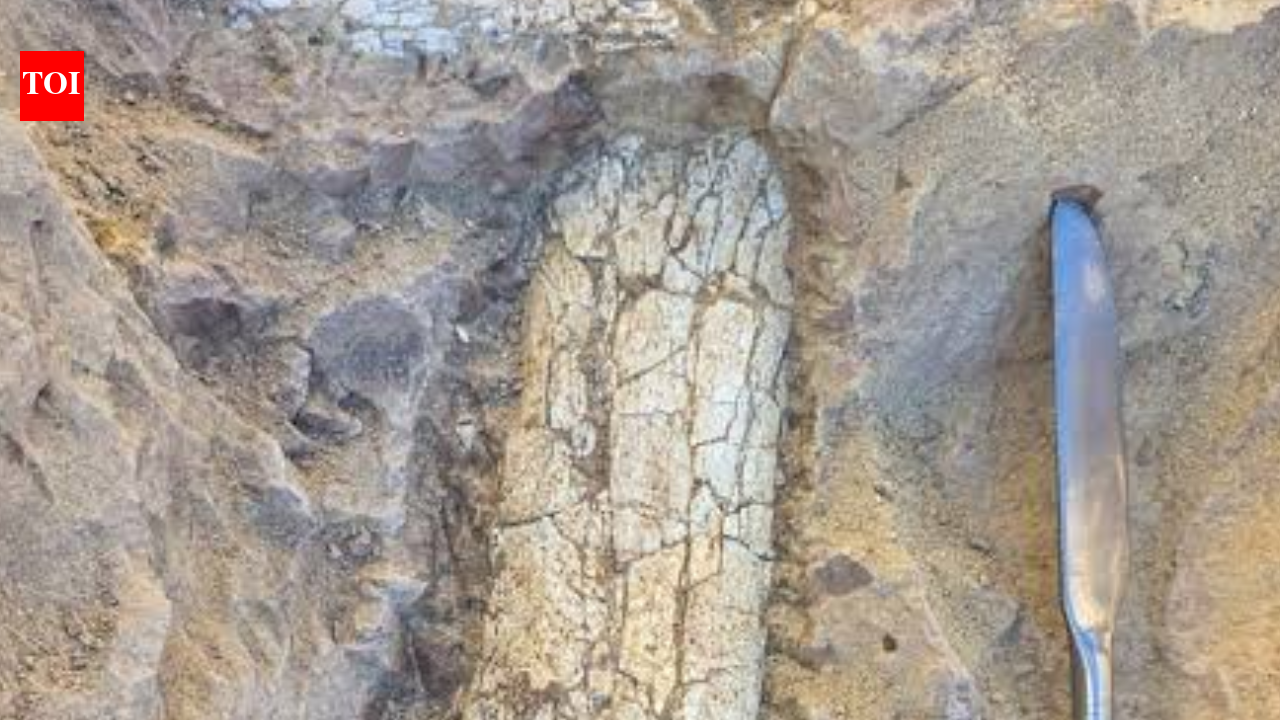
A routine infrastructure project in Oceanside, California, has uncovered a glimpse of a world that existed tens of millions of years before humans. The City of Oceanside first announced the discovery on September 22, while reporting from the Los Angeles Times, NBC 7 San Diego and the San Diego Union-Tribune provided additional details about the excavation and the scientists working to identify the animal. The fossilised remains were found about 12 feet beneath the surface during excavation for a city water infrastructure project. Several limb bones, ribs and other fragments were recovered, with the largest bone measuring more than two feet long, according to the Los Angeles Times. What makes the discovery particularly intriguing is that scientists still cannot say exactly what animal the bones belonged to.
A mystery buried beneath modern Oceanside
Paleontologist Joseph El Adli was conducting routine monitoring at the construction site when he spotted what appeared to be bone protruding from the excavation. The discovery prompted the area to be secured and the excavation to shift from ordinary construction work to a careful fossil recovery operation.The fossils were embedded in the Santiago Formation, a sequence of sedimentary rocks found across parts of northwestern San Diego County. The particular section where the remains were found dates to the Eocene Epoch, a period that lasted from about 56 million to 33.9 million years ago.At the time, Southern California looked nothing like it does today. The region was warmer, wetter and heavily vegetated, providing habitat for large herbivorous mammals that have long since disappeared.The fossils have been dated to roughly 40 to 45 million years ago, placing them within the Uintan North American Land Mammal Age.
Scientists have two possible suspects
Based on the size and shape of the recovered bones, El Adli has narrowed the possibilities to two extinct groups of odd-toed hoofed mammals.One is the Brontotheriidae, a family commonly associated with animals nicknamed thunder beasts. These large herbivores were related more distantly to today’s horses and rhinoceroses and included species with substantial bodies and distinctive skulls. Some brontotheres developed prominent bony projections on their noses.The other possibility is an amynodont, an extinct group of rhinoceros relatives sometimes described as swamp rhinos. They were generally hornless and had broad, barrel-shaped bodies. Some species are believed to have spent considerable time around water.Both possibilities fit the broad picture provided by the bones, but the researchers need additional anatomical evidence before they can make a more precise identification. The skull, teeth or lower jaw would be particularly valuable because those features can provide clues that isolated limb bones cannot. (NBC San Diego)
Seven days beneath tonnes of rock
Finding the fossils was only the beginning. Once the bones were spotted, El Adli and his team spent seven days carefully exposing them from several tonnes of hardened mudstone and sandstone.The work was done largely by hand to avoid damaging the fragile material. NBC 7 reported that roughly six feet of rock had to be removed by hand to reach the bones from the excavation where they were first identified. (NBC San Diego)After the bones were exposed, they were protected inside a plaster field jacket. This is a standard fossil-recovery technique that allows fragile specimens, along with some of the surrounding rock, to be transported without breaking apart.The fossils have now been moved to an off-site laboratory, where specialists will remove the remaining rock and stabilise the bones with conservation materials.
The find could reveal more about ancient California
The discovery is also significant because it adds to the growing fossil record of the Santiago Formation. Fossils from the formation have previously revealed that the San Diego region supported very different ecosystems during the Eocene.Researchers hope that further preparation will reveal enough anatomical detail to identify the animal more precisely. If additional bones, teeth or jaw material are found at the site, they could provide even more information about the species and how it lived.For now, the City of Oceanside is keeping the precise discovery site confidential. Officials say the decision is intended to protect both public safety around the active construction area and the fossil locality itself from unauthorised digging.The fossils are ultimately expected to become part of a museum collection, where they can be preserved and made available for scientific research and public viewing.For a project designed to build part of modern Oceanside’s infrastructure, the excavation has unexpectedly opened a window into a much older California, one where enormous hoofed mammals moved through a warm, forested landscape roughly 40 million years ago.