


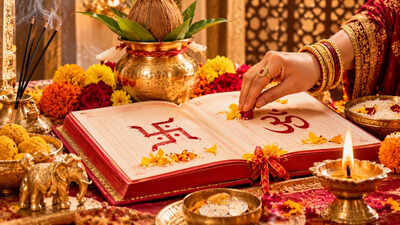
In Gujarati and Marwari business families, Diwali night includes a ritual almost as important as the Lakshmi puja itself. Red cloth-bound account books, called chopda or bahi-khata, are placed before the goddess, marked with kumkum and worshipped with flowers and lamps. They write the first line of the new year’s accounts in them. Even in an age of spreadsheets and accounting software, many traders still keep this tradition alive. Vastu Shastra adds practical guidance on where, how and when to do it, so the year’s business begins on solid ground.
When to Perform Chopda Pujan
Most families perform Chopda Pujan on Diwali, Sunday, November 8, 2026. The evening Lakshmi puja muhurat in Pradosh Kaal is a popular choice. Many traders also prefer the Nishita muhurat around midnight, when Amavasya is at its deepest and the night’s energy is considered strongest for wealth rituals.Some families open the new books on the morning of Bestu Varas, the Gujarati New Year, on November 10. Others wait for Labh Pancham, the fifth day of the bright half of Kartik, which falls around November 14 this year. That day is traditionally linked with profit and is when many shops reopen after the festival break.
Where to Place the Books
Face north or east during puja. The person performing the puja should face north, the direction of Kubera, or east, the direction of the Sun. Facing north is especially favoured for financial rituals.Keep the books on a raised surface. Place the account books on a wooden chowki covered with red or yellow cloth. Never put them directly on the floor, which is considered disrespectful to Lakshmi.Position near Lakshmi and Ganesha. The books should sit in front of or slightly to the right of the idols. Ganesha is worshipped first, as the remover of obstacles, before the books are honoured.In the shop or office, the cash counter and account books are best kept in the north zone. The owner’s seat ideally sits in the south-west, facing north or east. This arrangement is believed to support stable decisions and a steady income flow.
Preparing New Books
Pick out new books with a red cover, the traditional colour of good starts. Clean the puja area and the shop thoroughly beforehand.Draw a swastika with kumkum or sindoor on the first page. Below it, many families write “Shubh” on one side and “Labh” on the other. Shubh means auspiciousness, and Labh means profit. They’re also considered the sons of Ganesha.At the top of the first page, write “Shri Ganeshaya Namah” or simply “Shri.” Some families write the name of their family deity as well.Place a silver coin, a few grains of rice, turmeric and a small betel nut on the open page during the puja.
Worshipping the Tools of Trade
Chopda Pujan isn’t only about books. The tools that help earn a living are honoured too.A new pen, often dipped first in kumkum or red ink, is worshipped and used for the first entry. Weighing scales, a calculator, the cash box and the shop keys are placed near the puja area and marked with a small tilak.For businesses that run on computers, many families place a small swastika on a sticky note on the laptop or system and offer a flower. The idea is the same: respect the instruments that bring income.
The First Entry
After the puja, the head of the business writes the first entry of the new year. It’s usually a small, symbolic amount, often an odd number such as 11 or 21 rupees, entered as income. Some families enter a small donation instead, starting the year with an act of giving.Mercury is still retrograde until November 13 this year. That’s a good reason to keep the first entry simple and avoid signing big contracts that night. Larger business decisions can follow after mid-November.
Old Account Books
The previous year’s books shouldn’t be thrown away immediately. Keep them neatly in a cupboard on the south or west side of the office, bound and labelled. They record past effort and should be treated with respect.