

Rubber vine began its Australian story as a garden ornamental brought from Madagascar, and it has since become one of the country’s most troublesome weeds. Left unchecked, this glossy, trumpet-flowered climber can scramble up to 30 metres into tree canopies, blanket creek lines, smother the native vegetation beneath it, and form dense thickets. It also poisons people and livestock, makes mustering cattle difficult, and reduces food and shelter for native animals. Whether you farm, manage land, garden, or simply care about the bush, knowing how rubber vine spreads, how to recognise it, and what the law requires of you matters.
How rubber vine arrived in Australia, from a Madagascan garden to an invasive weed
Rubber vine is native to southwestern Madagascar, and the New South Wales Department of Primary Industries and Regional Development, through its WeedWise service, notes that it now grows across East Africa, Southeast Asia, the United States, and Central and Southern America. In Australia, its story starts in the 1860s, when it was planted in the gardens of northern Queensland mining towns. By 1917, people were already reporting infestations. During the Second World War, it was grown as a possible source of rubber, which did nothing to slow its movement.From those early plantings, it spread through much of Queensland, the south of Cape York, the Gulf of Carpentaria, the coast as far south as Bundaberg, and west to the Northern Territory border. WeedWise includes a photograph of a Queensland infestation that covered an estimated 700,000 hectares in 1991, which gives a sense of how far one garden plant can travel.
How to identify rubber vine, glossy leaves, trumpet-shaped flowers and paired seed pods
Rubber vine is a perennial, many-stemmed woody shrub or vine. Without support, it grows as an untidy shrub roughly two to three metres tall. Given something to climb, it can reach 30 metres, according to both the New South Wales and Queensland government pages. It produces two kinds of stems. Branched, leafy stems grow up to two metres long, while long, unbranched “whips” of three to eight metres reach out and haul the plant up into nearby vegetation. Stems are smooth and greyish brown, and they ooze a milky sap when broken.The leaves are dark green and glossy, often with a reddish or purplish midrib and stalk. They are oval with a pointed tip, six to ten centimetres long and three to five centimetres wide, and they grow in opposite pairs. The flowers are large, showy and trumpet-shaped, with five light-purple, pink or white petals. Business Queensland, the Queensland Government’s business and industry information service, says flowering can occur at any time of year when moisture allows, with only June and July typically flowerless.The seed pods are the most distinctive feature. They are rigid and triangular in cross-section, up to 12 centimetres long, and usually sit in pairs at the end of a short stalk. Each seed carries a tuft of long, silky white hairs. The two agencies give different upper figures for seeds per pod, 450 in Queensland and 840 in New South Wales, but both agree the numbers are large.Several plants can be mistaken for rubber vine. Ornamental rubber vine has smaller, darker pink flowers and fruit shorter than ten centimetres, and it never has purple leaf stalks or midribs. Purple allamanda has leaves in whorls of three or more and rounded fruit. The native bower vine has hairy flowers with a red throat, much smaller pods about six centimetres long, and leaves made up of four to seven leaflets.
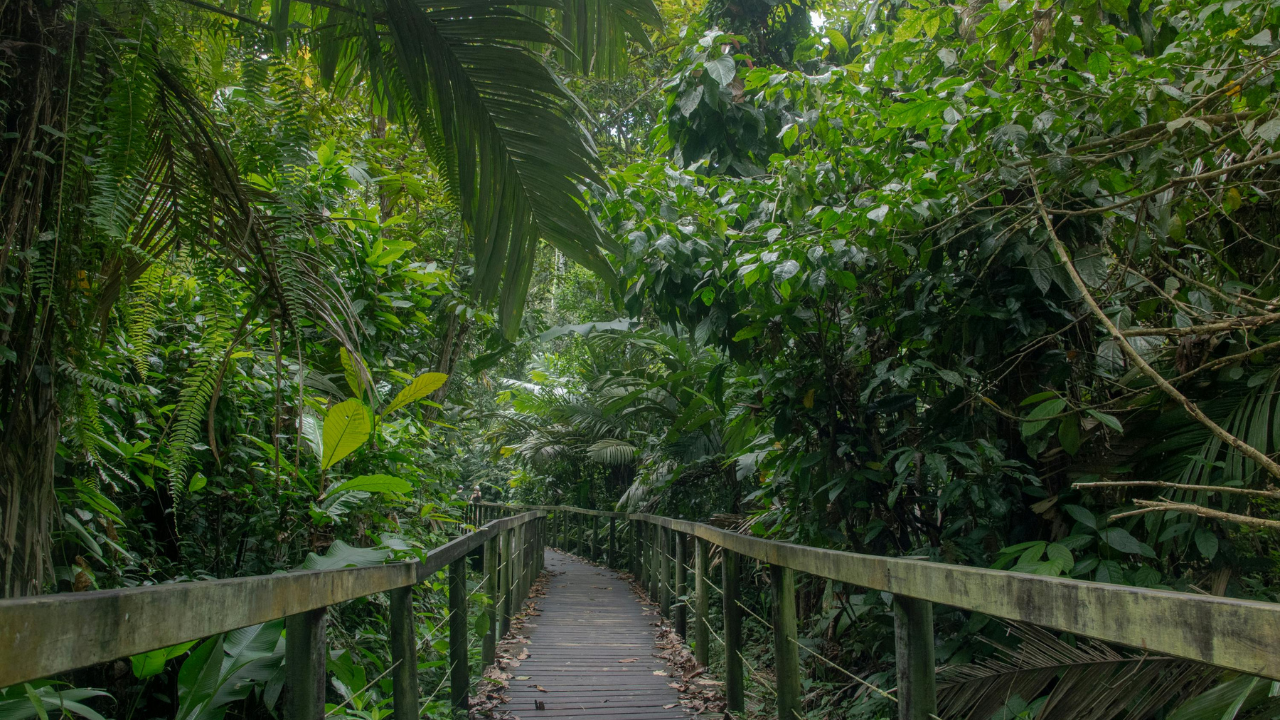
Given something to climb, the vine can reach 30 metres (Image: Canva)
How rubber vine smothers native forests, riverbank vegetation and pasture across tropical Queensland
Rubber vine grows best in semi-arid regions with tropical or subtropical climates, though it needs reliable water. That is why it so often takes hold along creeks, rivers and run-off areas. It tolerates shade and a wide range of temperatures, and only frost knocks back the growth above ground.Business Queensland describes how it smothers riparian vegetation, meaning plants along waterways, and forms dense thickets that spread outward onto hillsides and pasture. The result is lower biodiversity and barriers that impede both stock and native animals. The New South Wales WeedWise page adds that the weed can reduce food and shelter for wildlife and may lower water quality in streams. For graziers, the cost is practical: thick infestations make mustering difficult and take productive land out of use.
Why rubber vine spreads so easily and how roots reach 12 metres
According to WeedWise, a single hectare of rubber vine can produce millions of seeds each year, and about 95 per cent of fresh seed is viable. Most seed stays viable for six to eight months, although in very dry conditions most die within a year. Seeds can survive for more than a month inside floating pods, even in saltwater.Wind carries seeds short distances, while water carries them much further, because the pods float and ride creeks and floods downstream. Seeds can also catch in animal fur or travel in mud and soil on machinery. Business Queensland explains that pods dry and split open about 200 days after forming. Germination still depends on suitable temperature and soil moisture. Below ground, roots can reach 12 metres deep, which is one reason established plants are so hard to remove.
Rubber vine is poisonous, dangerous to cattle and people who touch or eat it
Every part of rubber vine is poisonous. WeedWise reports that it contains cardiac glycosides, compounds that affect the heart, brain and gut. Cattle, sheep, goats and horses are all at risk. Grazing animals rarely eat much unless other feed is scarce, but animals have died after eating dry leaves that had fallen to the ground. Cattle that have eaten even a small amount can die of heart failure after vigorous exercise, such as mustering. The most common sign is diarrhoea, often with blood.People are at risk too. The sap irritates skin and can cause burning, rashes and blisters, and dust from dried plants can irritate the throat, nose and eyes. If someone eats any part of the plant and is unconscious, unresponsive or struggling to breathe, call triple zero (000) or go straight to a hospital emergency department. If the person is conscious and responsive, call the Poisons Information Centre on 13 11 26 or contact a doctor, and take a piece of the plant for identification.
How to control rubber vine: Biological control with rust and moths
Business Queensland sets out a layered approach. Fire can control infestations when fuel loads are prepared first, and follow-up treatment is applied. Two successive annual burns are recommended, the first opens up the infestation and kills plants, and the second clears the regrowth. For scattered or medium-density infestations, repeated slashing close to the ground works well. For dense infestations, stickraking or blade ploughing in winter reduces the bulk, after which pasture is sown, windrows are burned, and follow-up work is done.Herbicides can be applied as foliar sprays, basal bark treatments, cut stump treatments or soil applications. Foliar spraying works best on actively growing plants under two metres tall, and not on plants that are water-stressed, yellowing or carrying pods. Cut stump treatment involves cutting within 15 centimetres of the ground and treating the cut surface immediately. Always read the product label and any permit before using a chemical.Two biological control agents are also established: rubber vine rust, a fungal disease, and a leaf-feeding moth. Both cause defoliation that appears to reduce seed production, but they do not usually kill established plants. Their effect depends on how abundant they are.In New South Wales, the advice is different. WeedWise asks people not to treat or dispose of rubber vine themselves. Report it, and the department’s Agriculture and Biosecurity team will lead the response.
Rubber vine laws in Queensland and New South Wales: What you must and must not do as a landholder
In Queensland, rubber vine is a category 3 restricted invasive plant under the Biosecurity Act 2014. You must not give it away, sell it or release it into the environment, and you must take all reasonable and practical steps to minimise the biosecurity risk it poses. Local governments also maintain biosecurity plans for invasive plants, and some of the actions in them may be required under local laws.In New South Wales, rubber vine is a prohibited matter under the Biosecurity Act 2015. Dealing with it is an offence; it must not be sold anywhere in the state, and anyone who sees or suspects it must notify the Department of Primary Industries immediately. WeedWise reports that rubber vine has been found at several properties in the north west of the state, mostly around homesteads and sheds, and that those sites are under an eradication program. If you spot a plant that looks like rubber vine in New South Wales, call the Biosecurity Helpline on 1800 680 244. In Queensland, contact Biosecurity Queensland through the Queensland Government’s website or by phone on 13 74 68.