


What does US President Donald Trump’s decision to waive sanctions on Russia and tariffs on countries buying oil from Moscow really mean for India? The US decision to waive the proposed sanctions under the Lindsey O. Graham Sanctioning Russia and Iran Act of 2026 is clearly aimed at securing relief for its own country.The development comes amid America’s shifting approach to Russian energy. In a separate deal, Russia agreed to release more than 300,000 metric tonnes of diesel for the US and global markets, with further supplies proposed for subsequent months.While the US-Russia diesel deal primarily focused on the bilateral US-Russia relations, the tariff waiver is mostly directed to India and China. The threatened 100% tariffs on the five largest buyers of Russian oil and gas were due to take effect 30 days after the legislation’s approval on September 18.Also Read | The return of Middle East oil: Has Iran lost control of Strait of Hormuz & why are crude prices still up?
What Trump has done
Trump invoked Section 115 of the Lindsey O. Graham Sanctioning Russia and Iran Act of 2026 to issue the waiver. He certified that it was in the national interest of the US.“I have submitted to the Congress a certification that the issuance of such a waiver is in the national interests of the United States and a report explaining the basis for the certification, consistent with section 115(b) of the Graham Act,” Trump said.The waiver applies to duties under Sections 112 and 113, which authorised tariffs of up to 500% on goods that are imported from Russia and up to 100% on goods from the five largest buyers of Russian-origin crude oil or natural gas. India and China were among the countries potentially covered by the latter provision.
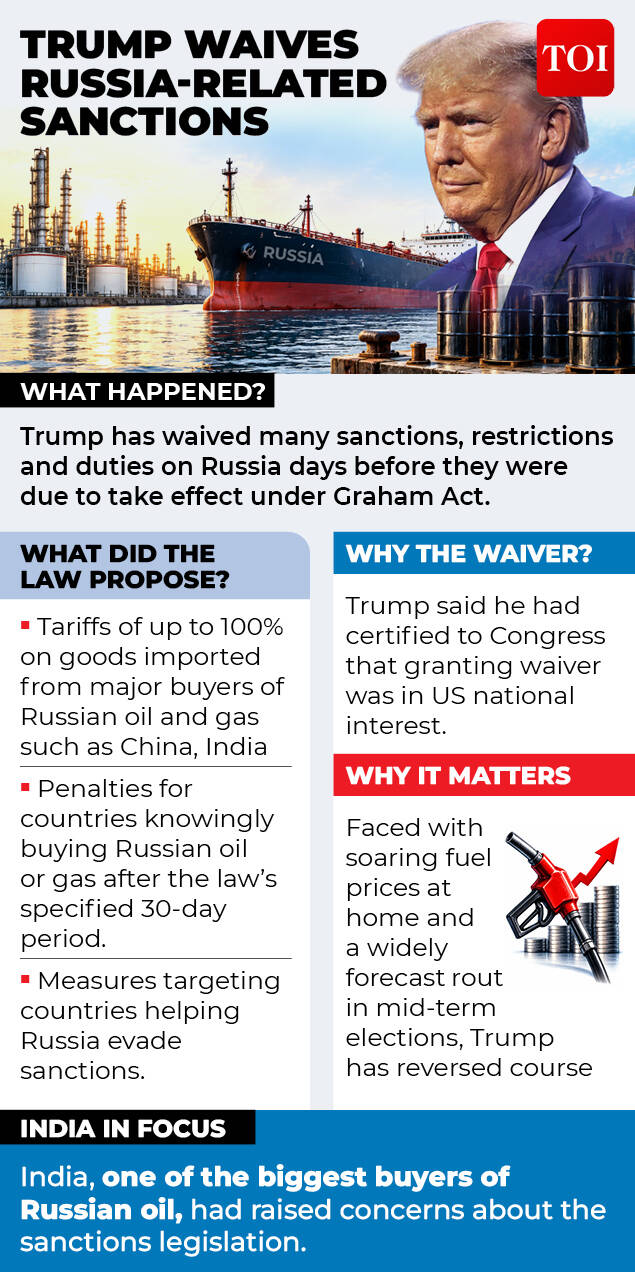
Trump’s sanctions and tariff waiver explained
But, Natalia Katona, Commodity Analyst sees the move as less of a gift to Moscow than an attempt to keep a lid on oil prices.“Russian crude continued to find buyers despite the tariff threat, effectively the entire November loading programme of Russian export grades has been sold off even though it could’ve been subjected to tariffs,” she tells TOI.“Enforcing the Lindsey Graham Act would risk disrupting future Russian crude flows and pushing Brent above its current level of around $110 a barrel. With US elections approaching in early November, my reading is that Trump wants to avoid another oil-price shock at all costs,” she says.
What it means for India
For India, the immediate relief is for its crude supply basket and exporters. If India decided to give up Russian crude oil, its single largest supplier would have gone off the table, with no easy replacement amid Middle East tensions. If it continued to buy Russian crude, then the 100% tariffs would have weighed on its exports to the US.Russian oil supplies to India hit a record high earlier this year when the closure of Strait of Hormuz limited the Middle East crude supplies.But recently, buying patterns have made a notable shift to the Middle East as supplies through the Strait of Hormuz ease and China begins competing for the same Russian barrels, driving up the cost of oil from Moscow.Pankaj Srivastava, Senior Vice President, Commodity Market – Oil at Rystad Energy is of the view that India was strategically prepared for the Graham bill, with crude supply from the Middle East rising significantly to approximately 2.5 million bpd in September, while Russian imports declined to around 1.5 million bpd.The increase in Middle Eastern supply was supported by the continued operation of multiple logistics channels, including the Strait of Hormuz, dark fleet movements, ship-to-ship transfers, alternative Red Sea and Suez Canal routes, and the East-West Pipeline.“As a result, Middle Eastern crude exports increased to nearly 15 million barrels per day in September, strengthening India’s import availability. At the same time, higher insurance and freight costs associated with Black Sea exports, following recent attacks in the region, reduced the competitiveness of Russian crude,” Pankaj Srivastava tells TOI.According to the expert, with ongoing refinery expansions and strong diesel crack margins supporting exports, the waiver further improves feedstock security for Indian refiners.“This development is also constructive for global distillate markets and could provide additional support to diesel and jet fuel balances in the US and Europe,” he says.In addition, Abu Dhabi National Oil Company’s decision to align Murban crude pricing with Dubai Platts from 1 November is expected to enhance pricing transparency and improve procurement flexibility for Asian refiners.“Overall, the combination of the Russian waiver, increased Middle Eastern supply, the UAE’s evolving position within OPEC, and the Murban pricing changes is positive for Indian refiners, strengthening their potential to increase diesel and jet fuel exports and generate economic benefits,” he adds.
The caveat
One very important point that is worth noting is that this waiver is for a 60-day period. This is clearly indicative that any relief from sanctions for Russia, and tariffs for countries like India is at best temporary as of now.A day after suspending sanctions and tariffs linked to Russian exports, US President Donald Trump said on Saturday that he had not yet made a final decision on the issue. Friday’s executive order did not specify the duration of the waiver.
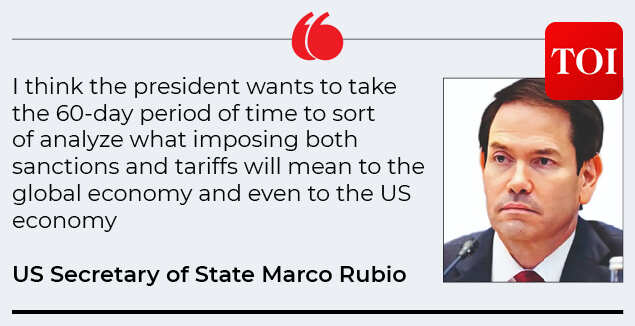
What Marco Rubio said about the waiver
US Secretary of State Marco Rubio, meanwhile, said the administration wanted additional time to assess the implications of the move.Rubio said Trump would take up to 60 days to examine the economic consequences of the Russia-related sanctions and tariffs he had waived a day earlier.Rubio said Trump had chosen to review the measures over a 60-day period.“I think the president wants to take the 60-day period of time to sort of analyze what imposing both sanctions and tariffs will mean to the global economy and even to the US economy,” Rubio said.Separately, Rubio also appeared to recognise the practical considerations behind India’s continued purchases of Russian crude.The issue has been a key subject of discussions between him and External Affairs Minister S Jaishankar since the US passed the Sanctioning Russia and Iran Act in September.“You also can’t unravel the economy of other countries because of one central issue. So that’s the complex part of having to balance all of this,” Rubio said according to PTI.Jaishankar is understood to have explained to Rubio that Indian refineries are largely designed to process medium-sour crude, which India sources from Middle Eastern countries and Russia.He is also understood to have pointed out the differences in the grades of oil available from other suppliers. Venezuelan crude is heavier, while US oil is lighter and would need to be blended before Indian refineries could process it.
Will crude oil become cheaper for India?
For India, however, relief from tariffs does not necessarily mean cheaper oil. In fact, even globally despite America’s diesel supply deal with Russia and the sanctions waiver, crude oil prices continue to stay near $110 per barrel.Pankaj Srivastava says the waiver was largely anticipated and is expected to provide modest support to crude prices while easing supply-side geopolitical risks for India.As Natalia Katona points out: Removing the threat also removes a potential deterrent for competing buyers of Russian crude.“So far, purchasing patterns show little sign of changing. For instance, China had already secured November-loading ESPO cargoes by early September, ahead of its usual buying schedule. India’s purchases by mid-October point to Russian crude flows of more or less the same 1.8 million b/d unchanged from September,” she tells TOI.
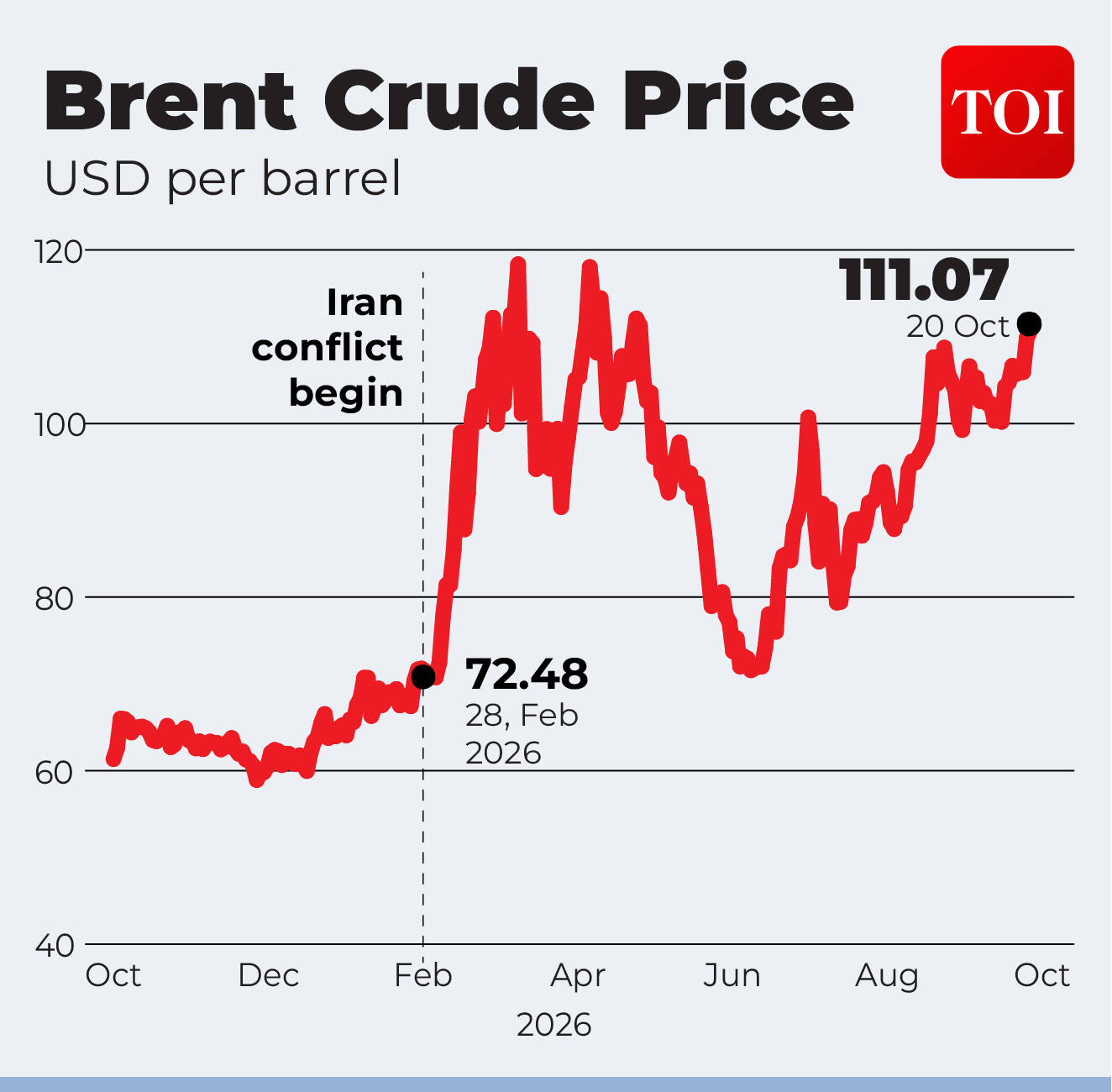
Brent Crude Price Trends
And, the pricing story is more complicated than the headline premium suggests.According to Katona, the Urals deliveries to India are generally priced against Dated Brent, which reflects the tight physical crude market.“Dated Brent was trading $20/bbl above ICE Brent futures for most of October and still is $10/bbl higher, therefore a cargo priced at Dated parity can still carry a substantial premium when compared to any other futures benchmark,” she explains.Urals has moved from a premium of around $8/bbl to Dated Brent a month ago to roughly Dated parity today, with a possibility for that differential to soften further.“Russian suppliers are adjusting to a higher physical benchmark and elevated freight costs to keep their barrels competitive. But a falling premium is not the same as a falling oil price,” she notes.“India may negotiate a better differential with Russian grades and will still face a higher outright bill if the benchmark itself (in this case, Dated Brent) rises. With China competing for Russian barrels and global physical supplies tightening, the waiver eases India’s tariff risk without resolving its supply problem,” she adds.But the weather may work in India’s favour over the coming months.In September-October, a total of 12 cargoes carrying Russian oil transited the Northern Sea Route, on their way to China.According to Katona, these flows should gradually halt as ice takes over most of the Arctic Ocean again, lowering the availability of Urals cargoes for China through the NSR.“Considering India is generally closer to Russia geographically (entailing a lower freight cost), from November onwards Russian sellers of grades loading in European ports (Urals, Siberian Light or Russian CPC) should have a general prevalence for Indian deliveries,” she believes.
India-US trade deal
The impending trade deal with the US is yet another important aspect of this whole equation.India and the US have been negotiating a trade deal for quite some time now with varying signals coming from time to time. Recently both the US and India indicated that the first phase of the deal is close to being finalised. Yet India has stressed that a trade agreement is possible only if it manages to gain a competitive advantage to its peers.The impending tariffs of up to 100% for India’s crude purchases from Russia would have weighed on the discussions. Now, what the waiver of tariffs does is give breathing space to India.Interestingly, Rubio on Monday said that the US was “very close” to concluding a trade agreement with India, and also indicated that the decision to grant a tariff waiver for purchases of Russian oil had been linked to the ongoing trade negotiations.“We’re trying to finalise the trade deal with India right now. We’re very close to doing that. So that’s one of the things we take into consideration when the President makes a decision about national security waivers and things of that nature,” Rubio said.But, Ajay Srivastava, founder, Global Trade Research Initiative (GTRI) says that India should not mistake that pause for lasting protection.China already has a separate assurance against tariff increases by the US until January 10, 2027, under the Busan agreement.“Washington can continue buying Russian diesel, leave China protected and keep the threat hanging over New Delhi,” Ajay Srivastava tells TOI.“Washington has bought Russian uranium and fertilizers and is now arranging purchases of Russian diesel. It has protected China against tariff increases under a separate agreement. Demanding an Indian price for withholding Russian-oil penalties would expose the selective nature of the policy,” he warns.Yet another factor is that Trump’s policies have done little till now to inspire confidence that any relief would be permanent.“Washington could invoke another statute, another investigation or another alleged grievance. India should insist on knowing exactly which US tariffs would fall, under what legal authority and for how long,” the GTRI founder says about the trade deal negotiations.“The US is entitled to negotiate for its interests. India is obliged to defend its own. It should not pay for permission to buy Russian oil from a government buying Russian diesel,” he says.