

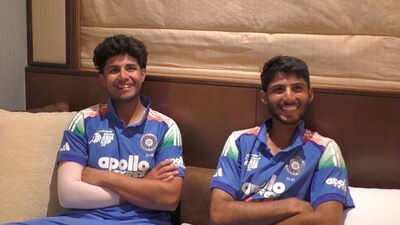
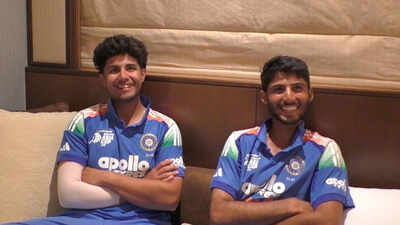
NEW DELHI: India’s Under-19 Asia Cup triumph over Pakistan was sealed only in the final moments of a gripping contest, but for the youngsters who experienced the pressure first-hand, the memories of that nerve-wracking evening will last much longer. From Aaryavir Sehwag battling a swollen arm to keep his team in the hunt to captain Lakshya Raichandani trying to stay composed amid the tension, the two heroes have offered a glimpse into the emotions that accompanied India’s thrilling title-winning chase.In a video shared by the BCCI, Sehwag and Raichandani looked back at the dramatic final in Oman, where India chased down Pakistan’s imposing 338-run target with a last-ball boundary from Mohit Ulva. Sehwag revealed how he chose to continue batting despite considerable pain after being struck on the arm, while also recalling how chanting ‘Sitaram, Sitaram’ from the dugout helped him remain calm as the match headed towards a tense finish.
‘I might not get the chance for India-Pakistan again’
Sehwag, who scored 58 off 61 balls, said his arm had gone numb after being hit and that the swelling was significant. However, the thought of potentially not getting another opportunity to play Pakistan in such a high-profile final pushed him to fight through the pain.“When I got hit on the arm, my arm went numb and it was really paining, it was really paining a lot. And when Suresh sir came, and he saw the swelling, he told me that, you know, it’s a lot of swelling. And then I was just thinking that I might not get the chance for India-Pakistan again, and definitely not in the final, the last Under-19 India event, and I could not leave India, my team like this, and I had to fight it out. And I am grateful to God that I got the power and courage to fight through that pain there, and contribute to the team, and it was amazing,” Sehwag junior said.The opener’s contribution proved crucial as India made a strong start to the chase before Pakistan fought back to put the result in doubt. Sehwag also revealed that he began chanting ‘Sitaram, Sitaram’ from the 32nd over, drawing comfort from the belief that India could still get over the line.“I had noticed Lakshya also. I don’t know which name he was chanting, but I was chanting “Sitaram Sitaram” from the 32nd over. So I was chanting it from the 32nd over, and obviously there was belief in the team, and quite a lot, you know, everyone was sitting in one place, not moving from their place. And everyone had the belief that the boys would do it, the boys would do it. And eventually, by God’s grace was there, and (Mohit) Ulva hit that final shot, and everything went in India’s favour,” said Aaryavir.The tournament turned out to be a memorable one for Sehwag, who was named Player of the Tournament after scoring 361 runs in five matches at an average of 90.25. His tally included a century and three fifties, while his 16 sixes were the most by any batter in the competition. He also struck half-centuries in both the semifinal and final.However, Sehwag insisted that winning the trophy had been his priority when he arrived for the tournament, rather than focusing on personal milestones.“So there were a lot of learnings, a lot of memories, and hopefully I will carry them forward,” he said.
‘The atmosphere was very tense’: Lakshya on final’s pressure
For captain Raichandani, the final was the culmination of an emotional campaign that had tested the team’s temperament as much as its cricketing ability.“It was an emotional roller coaster. That is right, everyone was very tense, the atmosphere was very tense, and everyone had the belief that the boys will do it, and they did it, hopefully. There were a lot of takeaways, and how to handle your emotion in such a pressure game, how to handle the pressure, how to keep calm, and what to say, when to say to players,” he added.Raichandani had also experienced a significant turnaround with the bat. After managing just 70 runs across his first three innings, he produced a superb 93 in the semifinal before scoring 80 off 101 balls in the final. He finished the tournament with 243 runs in five matches at an average of 60.75, including three half-centuries.The final itself had swung repeatedly. Pakistan, opting to bat first, posted 337/9, powered by Usman Khan‘s 107 off 111 balls, Abdul Qadir’s 80 off 54 and Farhan Yousaf’s 63 off 60.India’s response began positively, with Raichandani and Sehwag putting together a 95-run opening stand. But Pakistan’s bowlers fought back, leaving India precariously placed at 252/8 and turning the chase into a test of nerves.Manal Chauhan’s 47 off 32 balls and a crucial 67-run partnership with Ulva kept India’s hopes alive. After Manal’s dismissal, Ulva took responsibility for the finish, smashing an unbeaten 49 off just 26 balls, while Chigurupati Venkata remained unbeaten on 11 to provide valuable support.With India needing to navigate the final moments of a tense chase, Ulva found the boundary off the last ball to complete the victory. For Sehwag, Raichandani and the rest of the squad, it was the payoff for a campaign built on belief, resilience and the ability to handle pressure when the stakes were highest.