


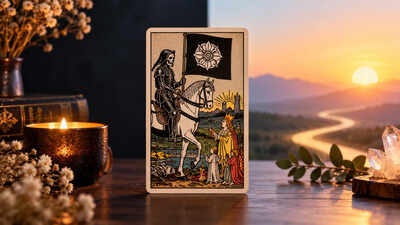
In films, it’s always the same scene. A fortune teller turns over a card, the music drops, and the camera zooms in on a skeleton. Everyone at the table goes pale. That moment has done more damage to the Death card’s reputation than anything else. Ask almost any experienced tarot reader, and they’ll say the card rarely, if ever, points to someone dying. It usually describes something far more common, and often more useful: an ending that clears the way for a new stage of life.
What the Card Actually Shows
The best-known version comes from the Rider-Waite-Smith deck of 1909. A skeleton in black armour rides a white horse. It carries a black flag marked with a white rose.In front of the horse, people react in different ways. A king lies fallen on the ground, his crown beside him. A religious figure stands with hands joined, facing the rider. A young woman turns her head away, and a small child looks up and offers flowers.Behind them, a river flows and a boat drifts along it. Far in the distance, the sun rises between two towers.That last detail is easy to miss, and it carries much of the card’s meaning. Death isn’t the final picture here. The new day is.The reactions of the figures matter too. The king, who stands for power and status, can’t stop what’s coming. The child, who has no fixed ideas yet, greets it without fear. Most people are somewhere in between.
What It Means in a Reading
Death is card number thirteen in the Major Arcana, the 22 cards that describe major life themes. Its core meaning is transformation through an ending.That ending can take many forms. A job that has run its course. A relationship that has quietly finished, even if nobody has said so yet. A belief about yourself that no longer fits. A home that the family is about to leave. The card says this chapter is closing, and holding on will only make the change harder.Readers often describe it as a card of necessary loss. Not every ending feels good. But the card suggests that what follows will have room to grow because the old thing has gone.When it appears reversed, the message shifts. It often points to resisting a change that’s already underway. Someone may stay in a situation long after it stopped working, out of fear, guilt, or habit. The reversed card can also suggest a slow, dragging transition rather than a clean break.
Why People Get It So Wrong
The name is the obvious problem. “Death” sounds final. The skeleton doesn’t help.The number adds to the fear. Thirteen carries its own superstitions in many cultures, from missing hotel floors to Friday the 13th.Pop culture fills in the rest. Films and television use the card as shorthand for doom because it looks dramatic on screen. Very few viewers ever learn what tarot readers actually say.Most traditional readers take a clear stance. Tarot, they say, isn’t a tool for predicting someone’s physical death, and responsible readers don’t use it that way.
The Scorpio Connection
In the system developed by the Hermetic Order of the Golden Dawn in the late 1800s, each Major Arcana card was linked to a sign or planet. The Death card was assigned to Scorpio.That pairing makes sense. Scorpio is the zodiac sign of endings and rebirth, linked with the eighth house of transformation. Its symbols include the phoenix, which burns and rises again.It’s also timely. The Sun is moving through Scorpio until November 22. Many astrologers see this season as a natural time to let go of what has run its course, which aligns with what the Death card has been saying all along.